# Model Context Protocol (MCP) for Solopreneurs: Connect AI Agents to Your Tools (Without Risky Copy-Paste)
If you’re running a solo business, every minute counts. Between marketing, customer support, managing your site, and delivering the work, it can feel like you need clones.
AI agents *should* solve that. But most “automation” still relies on fragile integrations or (worse) copy‑pasting data between tabs.
Model Context Protocol (MCP) is one of the biggest emerging shifts in AI automation because it standardises how AI apps connect to tools and data — with clear security principles like user consent and control.
## What is Model Context Protocol (MCP)?
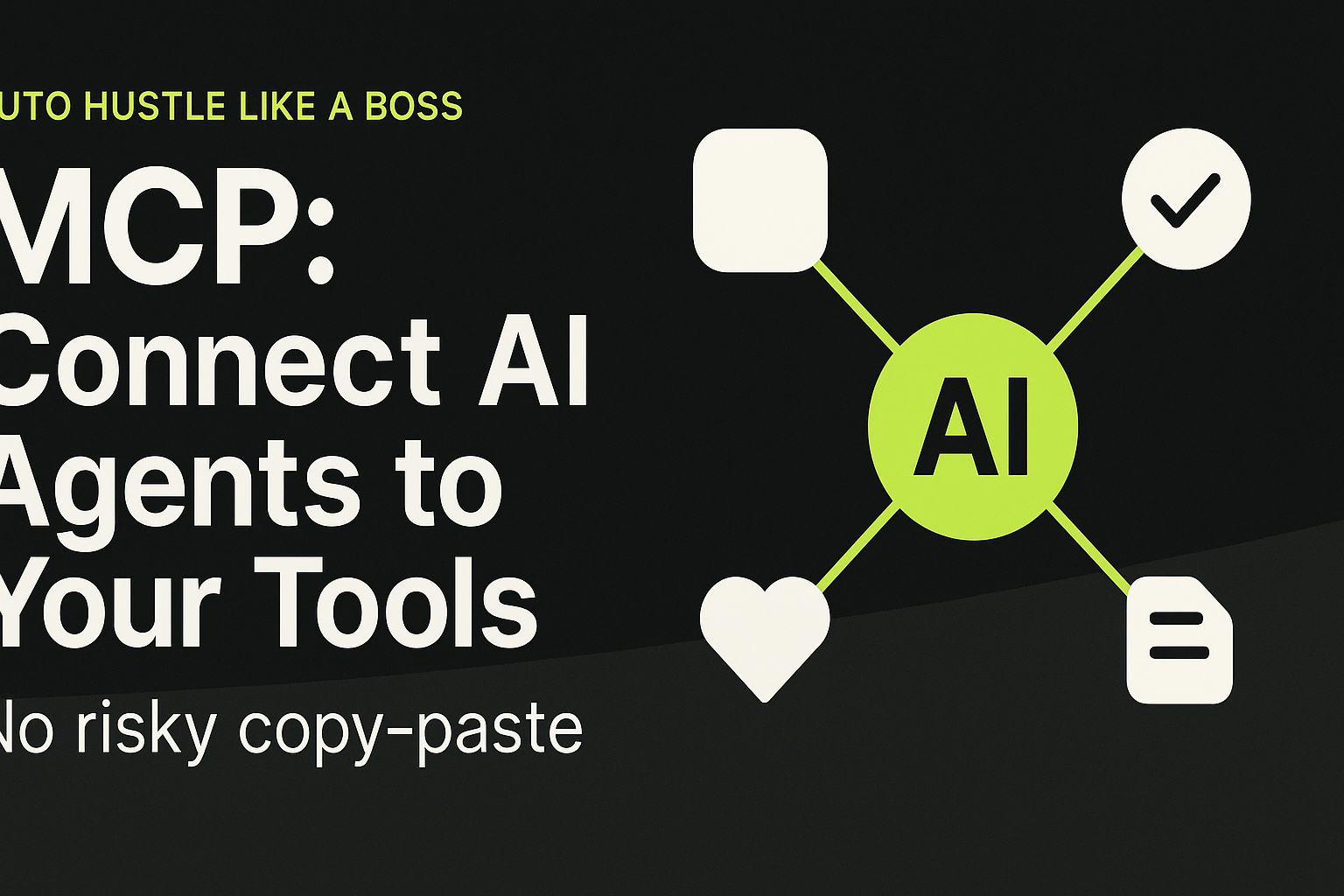
**Model Context Protocol (MCP)** is an open protocol that enables LLM applications to integrate with external data sources and tools in a standardised way. It’s designed so an AI “host” (an assistant or agent) can connect to **servers** that expose **tools**, **resources**, and **prompts** — instead of every app building a one-off integration.
- Anthropic introduced MCP as an open standard to build **secure, two‑way connections** between data sources and AI-powered tools (Anthropic, 2024-11-25).
- The MCP specification describes a client/server model, using JSON‑RPC messaging, capability negotiation, and emphasises **user consent, privacy, and tool safety** principles (Model Context Protocol Specification, 2025-11-25).
If you want the official reading, start here: [Introducing the Model Context Protocol](https://www.anthropic.com/news/model-context-protocol).
## Why MCP matters for solopreneurs
Solopreneurs don’t need more apps — they need fewer manual steps.
MCP is a trend worth paying attention to because it pushes the ecosystem toward:
- **Less copy‑paste** between ChatGPT/Claude and your business tools
- **More reliable connections** vs brittle, custom point-to-point integrations
- **Better guardrails** with explicit consent and clearer tool boundaries
In plain English: **you get agentic automation that’s safer to run in a real business.**
## What “agentic automation” actually means (without the hype)
Agentic automation is when an AI system does more than generate text — it can **take actions** across your tools.
For example, an “onboarding agent” could:
1. Read a new enquiry from your form
2. Draft a personalised welcome email
3. Create a task in your project board
4. Add a row to a tracking sheet
5. Notify you for approval before sending anything
The key is the approval + audit trail. That’s where MCP-style thinking fits nicely.
## A practical workflow: client onboarding that runs itself (with approvals)
Here’s a simple workflow you can build this week.
### Step 1: Pick one trigger
Choose *one* event that starts the automation:
- Typeform / Tally form submission
- Calendly booking
- Stripe purchase
### Step 2: Decide what the agent is allowed to do
Define the actions the AI can take:
- Draft emails (allowed)
- Send emails (only after your approval)
- Create tasks in Notion/Trello/Asana (allowed)
- Update a CRM record (allowed)
This aligns with MCP’s emphasis on **user consent and control** (Model Context Protocol Specification, 2025-11-25).
### Step 3: Use an automation layer (Zapier/Make/n8n) for the plumbing
You’re not replacing your automation tool — you’re upgrading what it can do.
For a refresher on no-code automation, see our internal guide: [The 7 Best No-Code Tools for Automating Your Side Hustle](https://www.autohustle.ai/blog/the-7-best-no-code-tools-for-automating-your-side-hustle).
### Step 4: Add the “agent” step (context + decision)
Your agent should be given:
- The form submission
- Your tone of voice rules
- Your offer details
- Any relevant FAQs
Then ask it to output:
- A draft email
- A short internal summary
- A next-step checklist
### Step 5: Add human-in-the-loop approval
Before anything customer-facing goes out, include a review step.
This isn’t just best practice — it’s the direction automation platforms are pushing as agents become mainstream. Zapier’s 2026-focused event materials explicitly highlight **agents** and **human-in-the-loop** as key themes (Zapier, 2025-12-03).
You can implement approval with:
- Email approval links
- Slack/Teams “Approve/Reject” buttons
- A Notion status field
## Where passive income fits in
MCP won’t magically create passive income — but it *does* make it easier to build **systems that keep running**.
Use this approach to automate:
- Digital product fulfilment (send files, grant access)
- Course onboarding sequences
- Support triage (categorise, draft replies, escalate)
- Content repurposing pipelines
That’s how you go from “side hustle” to “semi-passive machine”.
## Key takeaways
- MCP is an open protocol for connecting AI apps to tools/data in a standardised way (Anthropic, 2024-11-25; MCP Spec, 2025-11-25).
- For solopreneurs, the win is fewer manual steps + safer automations.
- Pair agentic workflows with **approvals** so you get speed *and* control.
## References
- Anthropic. (2024-11-25). *Introducing the Model Context Protocol*. https://www.anthropic.com/news/model-context-protocol
- Model Context Protocol. (2025-11-25). *Specification*. https://modelcontextprotocol.io/specification/2025-11-25
- Zapier. (2025-12-03). *Automation Now + Next: AI, Agents, and What’s Coming in 2026* (event page). https://zapier.com/resources/events/automation-now-next-ai-agents-and-whats-coming-in-2026
No items found.