The no-code revolution made building software accessible to non-developers. AI has made it fast. In 2026, a determined solopreneur with a good idea and 30 days can ship a working software product to real paying customers — no coding required.
This isn't theoretical. Micro SaaS products are being built and launched every week by people who couldn't write a line of Python six months ago. Here's the 30-day playbook.
Week 1: Find the Problem Worth Solving
The single biggest mistake in micro SaaS is building something you think is useful rather than something people are actively trying to solve. The difference between a product that gets 200 signups and one that gets 2 is almost always the quality of the problem, not the quality of the solution.
Spend week one on research, not building:
- Read the complaints and "I wish there was a tool for..." posts in Reddit communities, Facebook groups, and Slack communities in a niche you know well
- Look at existing tools in the space and read their negative reviews — what are users consistently frustrated by?
- Talk to 5-10 people in the target audience. Ask them what tools they use, what they hate about those tools, and what they do manually that they wish was automated
You're looking for a specific, recurring pain — not a broad category. "I need a better CRM" is a category. "I spend two hours per week manually copying client updates from email to my spreadsheet" is a pain you can build a product around.
Week 2: Validate Before You Build
Before you write a single no-code workflow, get pre-validation. Create a simple landing page (Carrd or Webflow — takes 2 hours) describing the tool and its core benefit. Add a waitlist signup or a "pre-order" button at the real price you intend to charge.
Share the page in the communities where you found the problem. If people sign up, you've validated enough to build. If nobody signs up despite targeted sharing, revisit your problem framing or your audience.
Aim for 50 waitlist signups before you build. That's a small but real signal that people care.
Week 3: Build the MVP
Build the minimum version that solves the core problem. Not all the features — just the one thing that makes the pain go away.
The no-code stack that works for most micro SaaS products:
- Bubble — best for web apps with databases, user accounts, and custom UI
- Glide — fastest for data-driven apps that sit on top of Google Sheets or Airtable
- Make (Integromat) — best for workflow automation products where the product IS the automation
- Softr — fast for client portals and internal tools
Use Claude or ChatGPT throughout the build for troubleshooting, logic design, and copywriting. When you hit a wall in Bubble, paste the problem into Claude and ask for a solution — it'll usually get you unstuck in minutes.
Week 4: Launch and Charge From Day One
Launch to your waitlist before you feel ready. The MVP will be imperfect. That's correct. Real user feedback is worth more than another two weeks of polishing features nobody asked for.
Pricing: don't underprice out of fear. If your tool saves someone two hours per week and they bill at $50/hour, it's worth $100/month to them. Start at $19-49/month and raise it as you validate the value.
Set up payments through Stripe, LemonSqueezy, or Paddle. All integrate cleanly with no-code tools and handle the tax complexity automatically.
The Honest Numbers
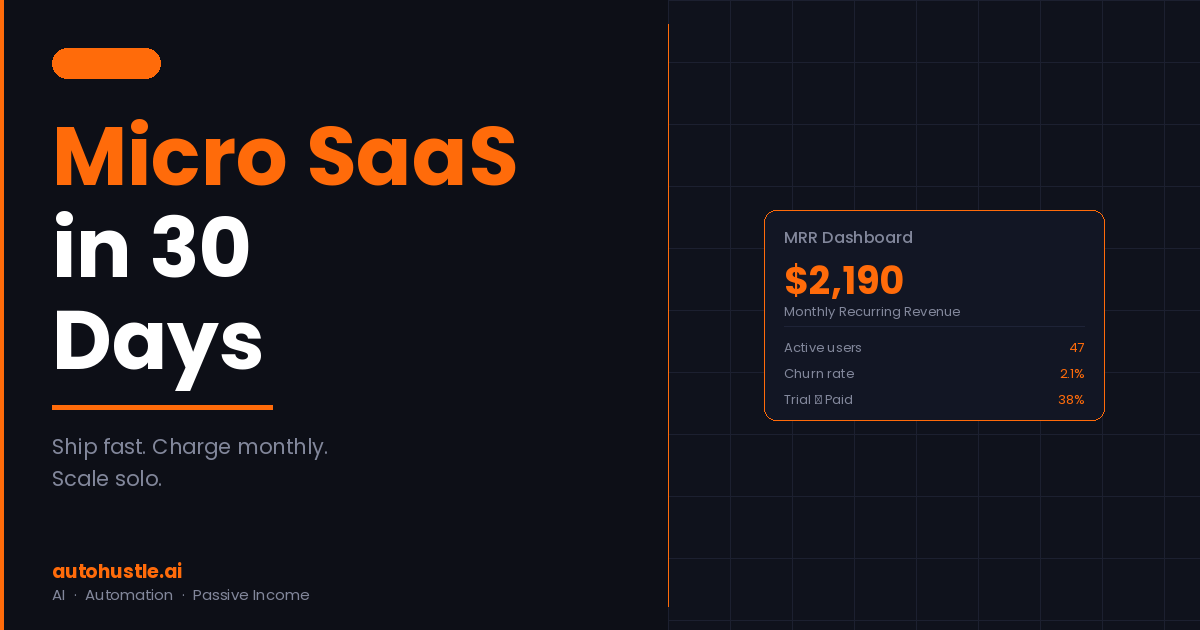
A micro SaaS with 50 paying customers at $29/month is $1,450 MRR. At 200 customers it's $5,800 MRR. These aren't life-changing numbers immediately, but they're recurring, compounding, and mostly passive once the product is stable.
Most successful micro SaaS founders launched something that half-worked, listened to early users, iterated for 90 days, and then found their product-market fit. The 30 days gets you to shipped. The next 90 days gets you to a real business.
Ship something. Then improve it. That's the whole playbook.