The AI Tool Question Everyone Is Asking
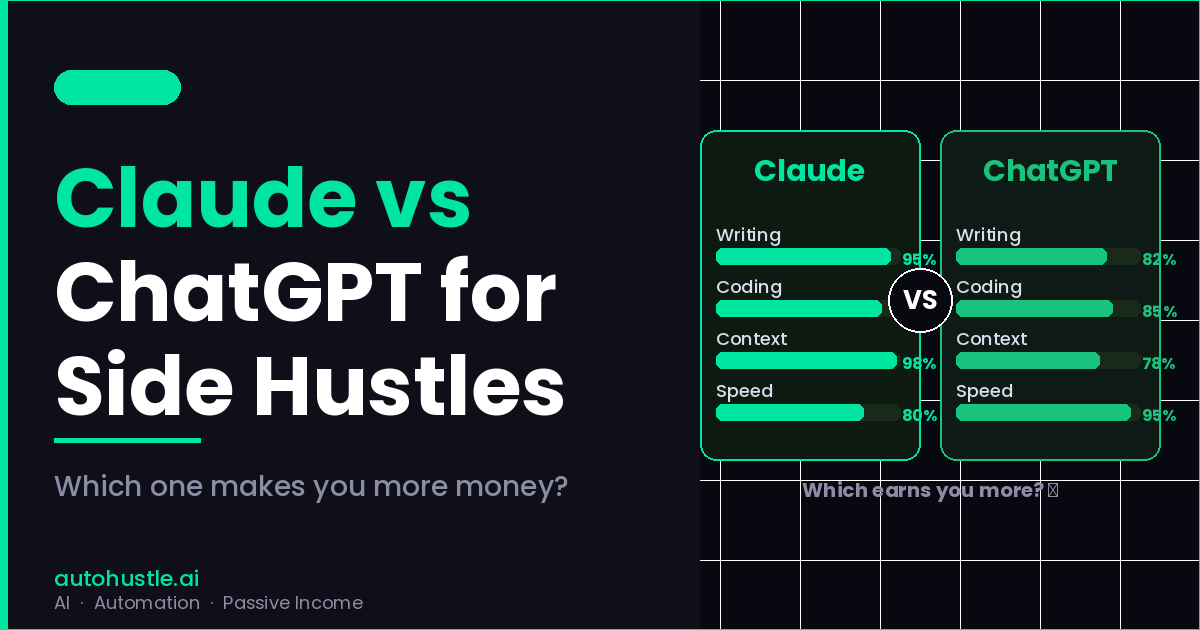
If you're building a side hustle with AI, you've almost certainly asked this question: Should I be using ChatGPT or Claude? Both are exceptional tools. Both have free tiers. Both can write, research, code, and brainstorm. So which one actually moves the needle for making money online?
We tested both extensively across the most common side hustle use cases. Here's the unbiased breakdown.
Round 1: Long-Form Writing and Content Creation
Winner: Claude
Claude (particularly Claude Sonnet and Opus) consistently produces longer, more nuanced, and better-structured long-form content. For blog posts, ebooks, email sequences, and sales copy, Claude tends to write with more natural rhythm and less detectable AI patterning. It's also significantly better at maintaining a consistent tone across a long document — critical if you're ghostwriting or building a content business.
ChatGPT's writing is excellent too, but tends to be more formulaic and template-like, especially for longer pieces. Where it shines is in shorter, punchy content like social captions, ad copy, and headlines.
Verdict for hustlers: If your income stream involves long-form content (blogging, ebooks, newsletters, ghostwriting), Claude is your primary tool.
Round 2: Research and Analysis
Winner: ChatGPT (with web access)
ChatGPT's real-time web search integration gives it a clear edge for research tasks. It can pull current data, recent news, and live pricing — all essential if you're creating content about fast-moving topics like AI tools, crypto, or market trends.
Claude has a later knowledge cutoff but no native real-time web browsing in its standard form. For research that needs to be current and cited, ChatGPT wins.
Verdict for hustlers: Use ChatGPT for market research, competitor analysis, and trend-based content. Use Claude to then write and structure what you've found.
Round 3: Coding and No-Code Automation
Winner: Claude
For side hustlers who want to build no-code tools, Zapier automations, or simple scripts, Claude tends to produce cleaner, more reliable code with fewer bugs. Its ability to hold a large codebase in context (Claude's context window is substantially larger than standard ChatGPT) means it can debug, refactor, and extend code without losing the thread.
Claude Code — Anthropic's dedicated coding tool — takes this even further, making it a serious option for anyone building AI-powered micro-SaaS products or automation services.
Verdict for hustlers: Claude for coding, building tools, and automation workflows.
Round 4: Brainstorming and Ideation
Winner: Tie
Both tools are exceptional brainstorming partners. ChatGPT tends to produce more quantity — longer lists, more options, more rapid-fire ideas. Claude tends to produce more quality — fewer ideas but better developed, more considered, and often more original.
For pure ideation sessions — naming a product, finding a niche, generating content angles — try both and see which resonates. Many serious hustlers use both simultaneously.
Round 5: Pricing and Value
Both tools offer free tiers with meaningful capability. Paid plans for both sit around $20–$30 AUD per month. The real differentiator is what you get for that subscription.
ChatGPT Plus unlocks GPT-4o, image generation via DALL-E, and real-time web search. Claude Pro unlocks extended thinking, larger context windows, and priority access to Sonnet and Opus models.
If you're choosing just one: Claude Pro delivers more value for content-heavy and research-heavy workflows. ChatGPT Plus is better if you need the Swiss Army knife — images, web search, and GPT plugins all in one place.
The Honest Answer
The side hustlers making the most money with AI aren't choosing one tool — they're using both strategically. ChatGPT for research and brainstorming. Claude for writing, analysis, and building. Together, they form a production stack that can replace an entire team.
Start with Claude's free tier for writing. Add ChatGPT's free tier for research. Upgrade whichever you use more. That's the move.